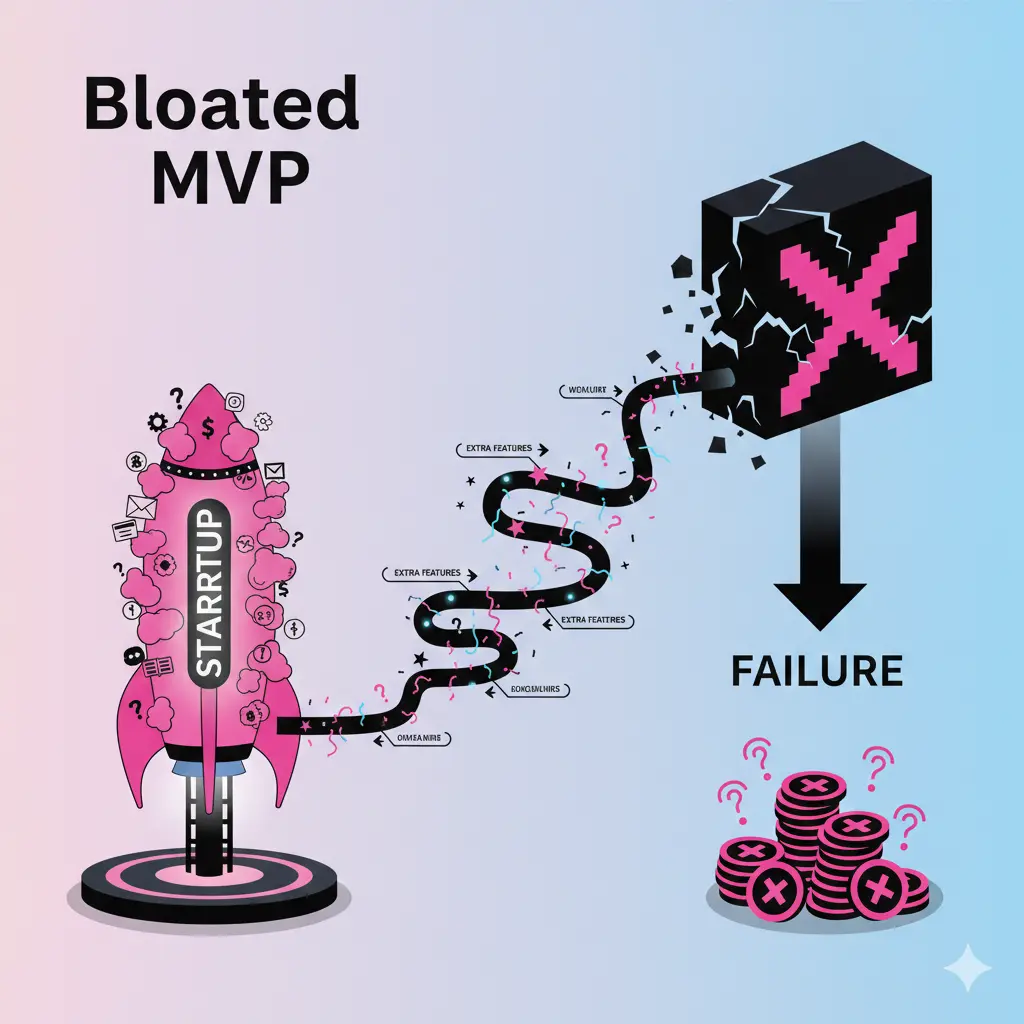
1. What is a Bloated MVP?
A truly "Minimum Viable Product" should address a single, core problem for a specific target audience with the simplest possible solution. A bloated MVP, in contrast, is an initial product offering that includes an excessive number of features beyond what is strictly necessary to test the fundamental business hypothesis. It's often driven by fear of inadequacy, a desire to impress investors, or an attempt to cater to every conceivable user need from day one. Instead of a sharp, focused tool, it becomes a Swiss Army knife trying to do everything, but excelling at nothing.
2. The Illusion of Completeness
Founders often succumb to the temptation of adding more features, believing that a "complete" product will be more appealing to users and investors. This "feature creep" can stem from:
-
Fear of Competition: Believing they need to match or exceed competitors' feature sets from the outset.
-
Perfectionism: A desire to launch a flawless product, even if it means endless iterations.
-
Stakeholder Pressure: Responding to every suggestion from advisors, investors, or potential customers without critical evaluation.
-
Overconfidence: An unwavering belief in the initial vision, neglecting the need for real-world validation.
This quest for completeness is an illusion. Early customers are often more interested in a solution to a pressing problem than a product laden with extraneous functionalities.
3. Key Ways a Bloated MVP Kills Startups
The consequences of a bloated MVP are severe and often fatal for nascent businesses:
-
Increased Time to Market (Delayed Launch): More features mean more development time, leading to significant delays. In a rapidly evolving market, these delays can mean missing the window of opportunity, allowing competitors to establish dominance or user needs to shift.
-
Higher Development Costs (Budget Overruns): Each additional feature adds to design, development, testing, and deployment costs. Startups typically operate on limited budgets, and a bloated MVP quickly depletes financial resources, often before any revenue is generated.
-
Loss of Focus and Core Value Proposition: An overwhelming number of features dilutes the product's core message. Users become confused about what the product actually does best, making it difficult to market effectively and stand out in the crowded marketplace.
-
Confusion for Early Adopters: A complex product with too many options can be overwhelming for early users. They struggle to understand its purpose and how to derive value, leading to poor adoption and negative feedback.
-
Technical Debt Accumulation: Rushing to build numerous features often leads to compromises in code quality, accumulating technical debt. This makes the codebase difficult to maintain, extend, and refactor later, leading to long-term performance issues and higher operational costs.
-
Missed Market Feedback: The primary purpose of an MVP is to learn from real users. A bloated MVP takes too long to build, delaying this crucial feedback loop. By the time it launches, the initial assumptions might be outdated, or the market need might have evolved, rendering much of the developed functionality irrelevant.
4. The True Power of a Lean MVP
A lean MVP, in contrast, empowers startups to:
-
Validate Core Hypotheses Quickly: Test the most critical assumptions about user needs and market demand with minimal effort.
-
Reduce Development Costs: Focus resources on essential features, conserving capital for iteration and scaling.
-
Accelerate Time to Market: Launch faster, gain early traction, and start generating revenue sooner.
-
Gather Targeted Feedback: Understand what features users truly value and where to invest future development efforts.
-
Maintain Agility: Remain flexible to pivot or adapt the product based on real-world learning.
Conclusion: Discipline and Customer-Centricity Over Features
The Bloated MVP Syndrome is a testament to the fact that in startup development, less is often more. The temptation to add "just one more feature" can be the deadliest trap for aspiring businesses. Success in the early stages hinges not on the breadth of functionalities, but on the depth with which a core problem is solved. Founders must exercise rigorous discipline, focus relentlessly on their core value proposition, and prioritize customer feedback over preconceived notions of completeness.
By embracing the true spirit of a Minimum Viable Product – building the simplest solution to test the most critical hypothesis – startups can conserve resources, accelerate learning, and dramatically increase their chances of navigating the perilous journey from idea to sustainable growth. The goal is to build a rocket with a single, powerful engine, not a luxurious cruise ship that never leaves the dock.